
Do You Need Separate AI Tools for Video, Image, Audio and 3D?
No — a small number of platforms now generate video, image, audio and 3D from one account and one credit balance, but most creators still juggle three or four separate subscriptions because most AI tools specialize in a single modality.
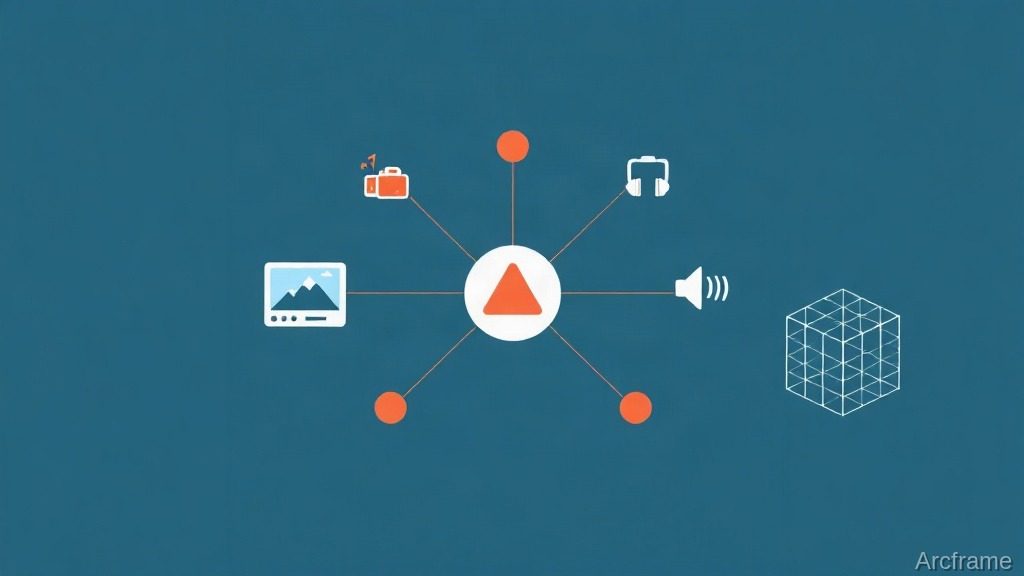
No — but most people end up with separate tools anyway, because most AI platforms only do one modality well. A typical creator stitches together a text-to-video tool, a separate image generator, a separate voice/TTS tool, and (if they need it) a separate 3D generator — four accounts, four logins, four credit balances, and four export-then-reupload steps to move an asset from one tool into the next. A smaller number of platforms, Arcframe among them, generate all four from a single account and a single shared credit balance instead.
Why this ends up as four tools instead of one
Most AI generation companies started with one modality and stayed there. That's not a flaw — a video-only company can go deep on video — but it means a creator building one piece of content (say, a product demo: a hero image, a narrated video, a voiceover, and a 3D render of the product) has to:
- Generate the image in Tool A, download it.
- Upload that image to Tool B to animate it into video.
- Generate the voiceover in Tool C, download the audio file.
- Sync the audio to the video manually, usually in a fifth, non-AI tool.
- Generate the 3D asset in Tool D, if the project needs one at all.
Each hop is a context switch, a re-upload, and a separate bill. None of the four tools know the other three exist, so there's no shared style, no shared prompt history, and no shared credit pool — a light month on video and a heavy month on audio still means paying for both subscriptions at their full rate.
What “one platform, four modalities” actually requires
For a single account to replace all four tools, not just claim to, it needs to satisfy three things:
| Requirement | Why it matters |
|---|---|
| Real model choice per modality | One video model or one voice does not compete with a category — creators need options, the way they'd have options across four separate specialized tools |
| One credit balance across all four | Otherwise you're just paying four bills through one login, which is convenience without the cost benefit |
| Assets that move between modalities without re-uploading | A generated image becomes the input to a video, a script becomes narration — if that requires downloading and re-uploading, the integration is cosmetic |
How Arcframe covers the four
Arcframe runs video, image, audio and 3D generation across 30+ models, all on one credit balance:
| Modality | What it covers |
|---|---|
| Video | Text-to-video, image-to-video, and turning a PowerPoint, PDF, or single image into a narrated video |
| Image | Text-to-image generation and image editing |
| Audio | Text-to-speech, including 11 Indian languages, plus voice cloning — clone a voice once, then narrate any future video in it |
| 3D | Image-to-3D model generation |
Because it's one account, a workflow like “turn this product photo into a 3D render, then generate a narrated video ad in Hindi using a cloned voice” touches three of the four modalities without leaving the platform or re-uploading anything between steps. There's also an MCP server, so the same generation can be triggered directly from inside Claude, ChatGPT, or Cursor rather than through a separate web UI.
Where separate specialized tools still make sense
An all-in-one platform is not automatically the better choice for every job, and it's worth saying plainly where it isn't:
- Deep post-production. If a project needs frame-by-frame video editing, professional color grading, or multi-track audio mixing, that's a dedicated editing tool's job, not a generation platform's — Arcframe generates the raw asset, it doesn't replace a timeline editor.
- A single modality at the absolute frontier. A team that only ever needs video, and needs the single best video model available regardless of everything else, may be better served chasing that one model directly than trading it for breadth.
- Team-specific model requirements. If a workflow is built around one specific model's exact output characteristics, switching platforms to consolidate billing isn't worth disrupting that.
The actual trade-off
The honest comparison isn't “one platform is always better” — it's “one shared credit balance across four modalities” versus “four separate subscriptions, each billed and topped up independently, each requiring you to move files between them by hand.”
For creators whose work regularly crosses modalities — a deck that needs to become a narrated video, a photo that needs to become a 3D render, a script that needs voiceover in more than one language — the shared-account version removes real friction. For creators who only ever touch one modality, it doesn't matter which model of platform they use, and going deep on a single-purpose tool is a reasonable call.
Arcframe's free tier is 20 one-time credits with no card required, which is enough to try all four modalities against your own project before deciding whether consolidating makes sense for your workflow. Current credit costs per model are listed on the pricing page, since those numbers change as models are added and are more reliable there than in a blog post that won't get updated.